Policy Reform
Introduction
Over recent years, freshwater policy in New Zealand has been caught in a cycle of political change. Each new government has introduced its own reforms, only for them to be repealed, rewritten or delayed by the next. Ngāi Tahu has dedicated significant time and effort to participating in these processes, yet much of that work is never fully implemented.
Ngāi Tahu wants to see a water governance and management system that transcends political cycles, grounded in long-term vision, stability and intergenerational thinking. Indigenous communities like Ngāi Tahu are uniquely positioned to provide that continuity.
The tribe’s 25-year vision, Mō Kā Uri, sets out intergenerational aspirations rooted in values, wellbeing and deep connection to the environment. Guided by this enduring perspective, the Ngāi Tahu approach to water management looks beyond short-term politics to safeguard the health of wai and the prosperity of future generations.
Te Kura Taka Pini (TKTP) leads engagement for Ngāi Tahu on freshwater matters within major freshwater and environmental policy reforms, particularly aspects of the Resource Management and Water Services reform. TKTP works to ensure these national reforms recognise Ngāi Tahu rangatiratanga, uphold the Ngāi Tahu Settlement and deliver enduring improvements to the health of freshwater across the Ngāi Tahu Takiwā.
Resource Management Reform
During the last two election cycles, the Resource Management Act (RMA) has been increasingly criticised by all major political parties for being too complex, slow and ineffective. It has failed to deliver environmental protection while also hindering housing, infrastructure and economic development. The Labour-led Government repealed the RMA in 2023 with two new Acts, but these were subsequently repealed by the National-led Government later that same year. The current Government is now preparing to introduce its own reforms later in 2025, with freshwater being one of the most challenging aspects of this work.
There will be two replacement Acts with clear and distinct purposes; the Natural Environment Act, to manage environmental effects arising from activities, and the Planning Act, to enable urban development and infrastructure.
TKTP actively engages with the Crown on the freshwater aspects of resource management reform. We are ready and willing to sit down with the Crown and work in partnership, recognising Ngāi Tahu rangatiratanga and Crown kāwanatanga, to design a better system that is solutions-focused and responsive to the local circumstances of the Ngāi Tahu Takiwā.
TKTP has identified the following key reform priorities:
- Upholding the Treaty of Waitangi and the Ngāi Tahu Settlement
- Enabling iwi to participate in the design and decision-making of the new system
- Addressing Crown assurances of Māori ‘rights and interests’ in freshwater
- Shifting to new water allocation models and trading
- Increasing use of resource-use charges and investment
- Setting environmental limits
- Improving monitoring, compliance, and enforcement
Beyond legislative change, TKTP’s focus is on implementation. The new system must deliver at all levels; nationally, regionally across the takiwā, locally for Papatipu Rūnanga, and for individual landowners. One of the RMA’s greatest failures was its focus on planning documents at the expense of implementation. TKTP is proactively exploring how a new system can best deliver tangible outcomes for Papatipu Rūnanga (tribal councils of Ngāi Tahu) and te taiao (the natural world).
Local Water Done Well
Te Kura Taka Pini is also involved in Crown engagement on water services reform, supporting Papatipu Rūnanga to improve water services within their rohe (territory).
Soon after being elected in 2023, the coalition Government repealed the Three Waters Reform legislation passed by the previous Labour Government. The National-led coalition’s Local Water Done Well reform places responsibility on local councils to determine how their water services are delivered.
The reform is underpinned by the Local Government (Water Services) Act 2025, which sets out governance options, regulatory standards and performance expectations. Councils can choose between maintaining control of water services in-house; forming a Council Controlled Organisation (CCO); or joining with other councils to form a multi-council CCO. The level of mana whenua involvement and decision-making within these new systems will depend on the strength of local relationships with councils.
TKTP advocates strongly for Ngāi Tahu and Papatipu Rūnanga priorities at both central and local government levels, and with Taumata Arowai, the water services regulator. The focus is on ensuring that all communities — regardless of size — have access to safe, resilient water services, and that these services contribute to improving the health of waterways across the Ngāi Tahu Takiwā.
Global Water Engagement
Te Kura Taka Pini engages internationally to strengthen freshwater outcomes at home, as well as contribute our expertise to shape global water decision-making. As an advocate for better freshwater governance in New Zealand, Te Kura Taka Pini contributes to international water dialogue to share our experience, learn from others, and support collective progress toward more sustainable and equitable water futures.
Exposure to international research and governance models generates new insight that informs strategy and policy development, strengthening freshwater outcomes locally.
Global engagement also creates space for Indigenous experts to connect across borders — strengthening collective capability and ensuring that Indigenous voices are not marginalised in water decision-making, whether locally or globally.
The knowledge, relationships and recognition gained internationally directly enhance TKTP’s ability to pursue improved freshwater outcomes for Ngāi Tahu and for all communities in New Zealand.
International engagement allows TKTP to:
- Contribute Indigenous-led perspectives on freshwater governance grounded in rangatiratanga and Māori values to global stakeholders
- Advocate for better approaches to global freshwater management
- Support global efforts to improve water security, quality and access
- Build partnerships that strengthen Ngāi Tahu freshwater leadership
- Influence global water governance arrangements and mechanisms that New Zealand may adopt in future
How we engage
Global water systems are under significant strain. Around the world, communities are grappling with declining water quality, inequitable access, climate pressures and governance systems that fail to protect rivers and drinking water for future generations.
Indigenous Peoples must be involved in decision-making processes and shape the design of collaborative approaches. Without a system that shares authority, the inequalities that created the water challenges people face today will continue to perpetuate.
Advancing progress on the UN Sustainable Development Goals is both a responsibility and an opportunity to improve freshwater protection and outcomes.
Te Kura Taka Pini actively participates in a range of international processes and forums that shape freshwater governance and policy, including:
- United Nations consultations and conferences focused on water and sustainable development; Global freshwater forums and multilateral dialogues;
- Indigenous-led gatherings and knowledge exchanges;
- Academic and policy collaborations advancing water research and governance innovation.
Recent Global Engagement
Te Kura Taka Pini’s recent international contributions include:
- Participation in global freshwater dialogues, including at the United Nations preparatory sessions held in Dakar, Senegal ahead of the 2026 United Nations Water Conference;
- Submission to the 2026 United Nations Water Conference stakeholder consultation;
- Contribution to the Indigenous Peoples’ Message that was coauthored by the Indigenous delegation at the 2025 World Water Week. A message from Indigenous Peoples to the global water family
- Recognition through the UN SDG Actions Platform for work advancing #SDGAction49300: Rangatiratanga over freshwater. Rangatiratanga over freshwater / Regulatory authority over freshwater based on Maori values | Department of Economic and Social Affairs
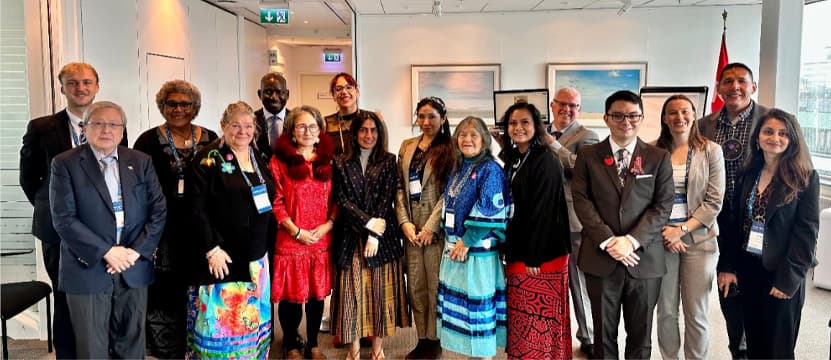
Indigenous representatives meeting with the co-hosts of the 2026 UN Water Conference